
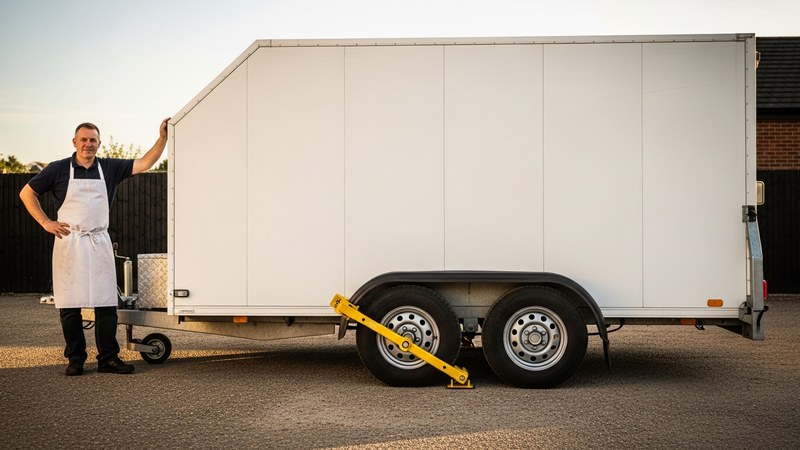
If you own and operate a food trailer, one of your biggest worries is having it stolen. You might think it won't happen to you — a friend of mine thought exactly that, until someone towed his trailer away in the early hours one morning, never to be seen again.
That's why now is the time to invest in proper, effective trailer security. Get it wrong and you could pay the ultimate price: the loss of the kit, the trailer, and the income it brings in. The good news is that a few sensible measures, layered together, make your unit a far harder target than the one parked next to it.
What security measures should I take?
There are several measures you can fit to a catering trailer, and they work best in combination. Here are the main ones — each links to a deeper guide where we have one.
Wheel clamp / wheel lock
Stops the wheels turning so the trailer can't be rolled or towed. Pick a high-quality, rated clamp. See our wheel clamps guide.
Hitch lock
Covers the coupling so nobody can hitch your trailer to a vehicle and drive off. Cheap, effective, and the natural partner to a wheel clamp.
Alarm system
Sounds a siren or flashes lights if someone tries to tow, rock or open the trailer — and can text or alert your phone. See our trailer alarms guide.
Good door & hatch locks
Standard trailers come with a basic door lock — add a padlock or two and bolster the serving-hatch catch, the usual weak point. See our trailer locks guide.
GPS tracker
A recovery option once a trailer is stolen. Fit a discreet tracker and you can pass its location to the police. Modern kits even alert your smartphone.
Security post
For overnight storage at home, a post cemented into the ground physically blocks the trailer from being towed away.
Extra steps for peace of mind
Security isn't only about locks. A few minutes of preparation makes a stolen trailer far easier to recover and identify:
- Take clear photos of the trailer from several angles, and of the equipment inside.
- Note the chassis-plate details and any security markings to hand to the police or your insurer.
- Record distinctive features only you would know, so you can prove it's yours.
- Some owners mark the roof so the trailer can be spotted by roadside and CCTV cameras.
Is trailer security really that necessary?
In a word, yes. Think about the equipment, stock and fittings sitting inside your trailer overnight. A thief could take or wreck the lot — and for some caterers that means closing the business until they can replace or hire another unit. Even fully insured, you'll likely face a premium hike, weeks of lost trading, and a lot of hassle.
No single measure will stop a determined thief, but a few used together make your trailer far more trouble than it's worth. Don't leave it too late. If you have a question about securing your unit, do get in touch.
Make security part of your setup, not an afterthought
The MobCater app's checklist covers security alongside gas safety, licensing and insurance, so nothing gets missed before you trade.
Open the free checklistFree 12-step guide forever · Checklist included in the app
Frequently asked questions
What's the single best security measure for a catering trailer?
There isn't one — layering is what works. A wheel clamp plus a hitch lock stops the trailer being moved; good door locks and an alarm protect the kit inside; a GPS tracker helps recovery. Use several together and you become a far harder target.
How do thieves usually steal a catering trailer?
Most often by simply hitching it to a vehicle and towing it away, or by forcing the serving hatch to get at the equipment inside. A hitch lock and wheel clamp deal with the first; good hatch and door locks deal with the second.
Will good security lower my insurance premium?
It can. Many insurers ask what security you have and may offer a better premium, or require approved measures for higher-value units. Fitting rated locks and an alarm also helps a claim go through faster if the worst happens.
Is a GPS tracker worth it?
For a higher-value unit, yes. A discreet tracker won't stop a theft, but it dramatically improves your chances of recovering the trailer — and some insurers look favourably on one being fitted.
How should I secure my trailer when it's stored at home?
Combine a wheel clamp and hitch lock with a ground-anchored security post so it physically can't be towed. Park it where it's overlooked if you can, and fit an alarm for good measure.