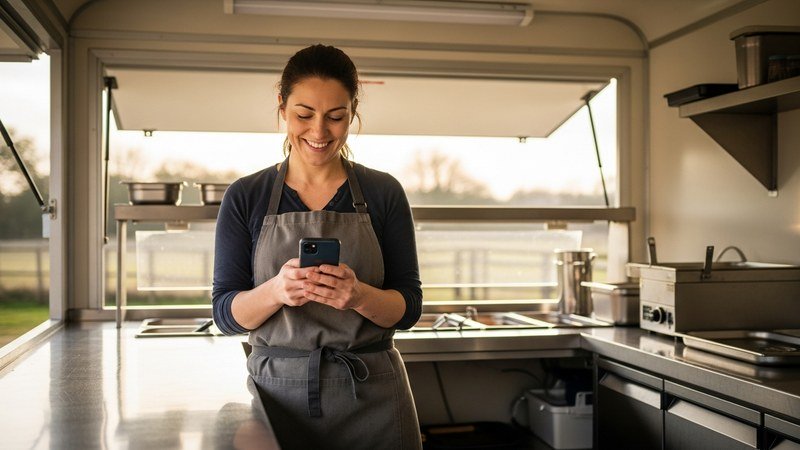
One of the first things I learned on a pitch is that customers cannot buy from you if they do not know you exist. New customers used to tell me "I didn't know you were here" all the time, and that was when they were walking past the van. Online it is even more true. These days almost everyone who books a caterer for an event, or looks up a burger van before driving over, does it on their phone first. This guide walks you through the three things that put you on that phone: a domain name, a simple website that wins bookings, and a Google listing.
Why your catering business needs to be online
You do not need a complicated web presence to run a successful catering round, but you do need to be findable. When someone searches "hog roast hire" or "burger van near me" with your town attached, the caterers who show up get the call. The ones who do not show up never even know the enquiry existed.
A website does three jobs for a mobile caterer. It makes you easy to find, so customers can check your menu, prices and contact details without having to message you and wait. It builds trust, because a professional site with real photos and reviews makes you look established, which matters enormously for wedding and event bookings where people are spending serious money. And it works while you are working. Enquiries arrive in your inbox while you are flat out on the griddle at lunchtime.
If you are still at the planning stage, get this sorted alongside your other prep. It sits naturally next to working out your start up costs and finding your pitch, and it is one of the cheapest parts of the whole startup.
Step one: choose and register your domain name
Your domain name is your address on the internet, and once someone else registers the name you wanted, it is gone. That is why I tell people to secure their domain early, even if the website comes later. At around £6 a year for a .co.uk domain it is the cheapest insurance policy in your whole business plan.
A good catering domain name is short and catchy, so it is easy to remember and type. It is brandable, so something like StreetBitesUK.co.uk will always beat a generic string of words. It is easy to spell, with no unusual spellings or hyphens that get lost when you say it out loud. And ideally it is descriptive, with a word like catering, grill or coffee in it so people instantly know what you do.
For a UK catering business I would go .co.uk every time. It tells customers at a glance that you are local, and local is exactly what they are searching for. If the matching .com is available cheaply, some caterers register it as well to protect the brand, and a few register two or three name ideas and decide later. That is fine, domains are cheap enough that it costs very little to keep your options open.
One more tip from experience: pick a name that still works if your menu evolves. My first van was called Snack Mobile, simple as that, and even basic branding got attention at eye level driving past. Any branding beats no branding, but a name you will not outgrow beats both.
Step two: a website that wins bookings, not just looks pretty
A catering website does not need twenty pages. It needs one really good page that answers the questions every customer has before they get in touch. After years of watching what works, here is what that page must include.
Your menu with prices, because "how much?" is the question behind every enquiry, and answering it up front filters out the tyre kickers and brings you serious bookings. Real photos of your unit and your food, because mouth watering pictures sell food and a smart looking van or trailer sells trust. Your contact details with a tap to call button, since most visitors are on phones and nobody wants to copy and paste a number. An enquiry or booking form, so event bookings can land in your inbox at any hour. Your reviews and ratings, because your five star reputation, hygiene rating and insurance are what win the wedding booking over the next caterer. And the area you cover, so people know straight away whether you travel to them.
Above all it must look right on a phone. Most of your customers will only ever see your website on a small screen, so if it is fiddly or slow on mobile, it is costing you bookings whatever it looks like on a laptop.
Is a Facebook page enough?
A lot of caterers start with just a Facebook page, and I understand why. It is free, it is quick, and your customers are on there. Keep it, it is a brilliant tool for posting where you will be trading and showing off your food. But on its own it has real limits. You do not own it, and a change to Facebook's rules or an account problem can switch your shop window off overnight. It barely shows up in Google searches, so the "catering near me" customer never finds you. And for event and wedding enquiries it simply looks less established than a proper website with your own domain name on the side of the van.
The combination that works is both: your own website as the permanent base that Google can find, with Facebook feeding it day to day.
Do it yourself, or have it done for you
If you have the time and patience, you can absolutely build your own site with one of the DIY website builders, and plenty of caterers do. Budget a good few evenings for it, expect some frustration, and keep the page focused on the essentials above rather than getting lost in design options.
If you would rather spend those evenings on your menu and your pitch instead, Websmartz builds websites specifically for UK mobile caterers. We have used them for a long time on our own sites, and the way they work removes the usual risk: they design your homepage as a free mock-up first, with your name and style on it, so you see exactly what your site could look like before you spend a penny. If you love it, they build the full site for £299, or £29.99 a month with nothing upfront. If not, the mock-up costs nothing and you are under no obligation.
I have put the whole thing on one page, the styles they build, the full what-you-get list and how the free mock-up works: get a website for your catering business.

Step three: get on Google with a Business Profile
Alongside the website, set up a free Google Business Profile. This is the listing that puts you on Google Maps and in the local results when someone searches for catering in your area, and for a mobile business you can set a service area rather than a fixed address. Add your photos, opening hours, menu link and website link, and ask happy customers to leave a review. Those reviews compound over time and they are often the deciding factor between you and the next van. While you are at it, claim the other free listings such as Yelp and the local directories. Each one is another road that leads customers to you.
Frequently asked questions
How much does a domain name cost in the UK?
Around £6 a year for a .co.uk domain, sometimes less in the first year. It is one of the cheapest parts of starting a catering business, which is why I recommend registering your name early even if you build the website later.
Should I choose a .co.uk or a .com domain?
For a UK mobile catering business, .co.uk is the better choice. It tells customers instantly that you are a local UK company, which is what they are searching for. If the .com is available cheaply, you can register it too so a competitor cannot use a similar name.
Do I need a website before I start trading?
No, you can start trading without one, and plenty of caterers do. But the earlier you are online, the earlier you start collecting enquiries and reviews. At minimum, register your domain name and set up a free Google Business Profile before launch, then add the website as soon as you can.
Is a Facebook page enough for a catering business?
It is a great start and worth keeping, but it has limits. You do not own it, it barely appears in Google searches, and it looks less established for event and wedding enquiries. The strongest setup is your own website plus an active Facebook page feeding it.
What should a mobile catering website include?
Your menu with prices, real photos of your food and your unit, contact details with a tap to call button, an enquiry form for bookings, your reviews and hygiene rating, and the area you cover. It must work well on a phone, because that is where customers will find you.
How do customers find my catering business on Google?
Two ways: a free Google Business Profile puts you on Google Maps and in local results for your service area, and a website set up around your business name and the towns you cover catches the “catering near me” searches. Reviews on your profile improve both over time.