Do you want to start a mobile catering business? It was the last thing on my mind once, and it turned into the best decision I ever made. If you are not sure what it is all about, or you would just like to know more, stay here with me and I will do my best to answer the questions I had myself when I started: what is it, how do you get going, what does the law want from you, how much can you make, and the honest pros and cons.
What a mobile catering business actually is
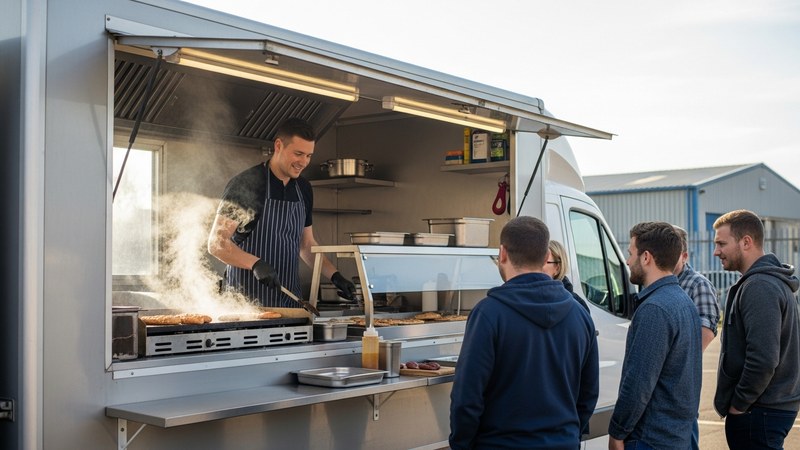
At its simplest, mobile catering means providing a hot food and drink service to people in a place where it is not already on offer. A remote location is ideal, especially where there are no other food traders nearby. You do it from a catering vehicle, which is really just a kitchen on wheels — a place where you prepare, cook and serve food ready to sell to the public.
People love the convenience of it, and a good unit sells a range of hot and cold food, from the usual burgers and rolls to sandwiches and healthier options like salads and vegetarian snacks. Unlike a typical fast-food chain where everything is mass produced in advance, you cook to order, so the customer has far more say in how their food is done. That personal touch is part of what keeps them coming back.
How do I start? Find your pitch first
Your number one priority is to find and secure a pitch — the location you will trade from. That can be a static site where your unit stays put, or a temporary site you trade from by day and tow home each evening.
So how do you find a site? Here are a few places to get you thinking:
- Ask at your local Sunday market
- Find a spot on an industrial estate
- Try a neighbouring car boot sale
- Train stations and bus stations
- Most large DIY stores allow space for catering trailers
These are just a few. Once you start looking around you will be surprised where a food service is needed, and how many possibilities are out there. And do not forget — your business is mobile. If a pitch is not busy enough, you can simply move on.
Legal requirements, hours and location
You will need a current Food Hygiene Certificate to cook and sell food to the public. It shows you have passed a test on food hygiene, and by law it must be displayed on your unit. You will also need an LPG (gas) test certificate and an electrical certificate to trade legally — these confirm your appliances, gas, pipes and electrics are safe. You should also register with your local council, who will visit and inspect your trailer to make sure you meet the food hygiene rules.
Location matters just as much as it does for any shop, but in a slightly different way. Ideally you do not want to be right next to other food traders. That is your unique advantage — your business is mobile, so within reason it can go where the money is. Just make sure you have a licence if one is required, or permission from the landowner.
Your hours are set by the location you serve. Trade a Sunday market and you might work just the one day; cater for workers on an industrial estate and your trading days run longer, five or six days a week.
The pros and cons, honestly
I have tried to be straight with you all the way through, so here is the balanced picture — the good and the not-so-good.
Pros
- Cheaper start-up than a shop
- No business rates (for now) and no long lease tying you down
- It is a cash business
- Little real competition — you picked the location
- You are in full control; it is your business
- Can be very lucrative
- You serve your own local area
- Expand at your own pace
- Shorter trading hours than most food retailers
- The personal satisfaction is high
Cons
- The initial outlay can be expensive
- Finding a pitch can be difficult
- A site may not have long-term prospects
- Hard work, with early starts
- You are responsible for the cooking and prep
- Very hot in summer, more so with the cooking heat
- A unit left overnight could be stolen
- Little time off unless you employ staff
- Working alone can be lonely
- If you are off sick, you do not get paid
So, is it worth it?
Now you have had a quick introduction to the opportunity and a few of the first steps, you can start to make up your own mind about whether this kind of business is right for you. I have been honest about the bits that are hard, but there is a lot more to the story than fits on one page.
If you are weighing it up but are not sure you have the courage to take it further, read on. In the next chapter I will tell you exactly how I got started myself — with no experience and only a tiny dose of courage.
Walk the same journey, step by step
David learned all of this the hard way. The free MobCater app turns it into a clear 12-step path, from market research to your very first trading day, with a checklist so nothing gets missed.
Open the free 12-step guideFree 12-step guide forever · no credit card needed