
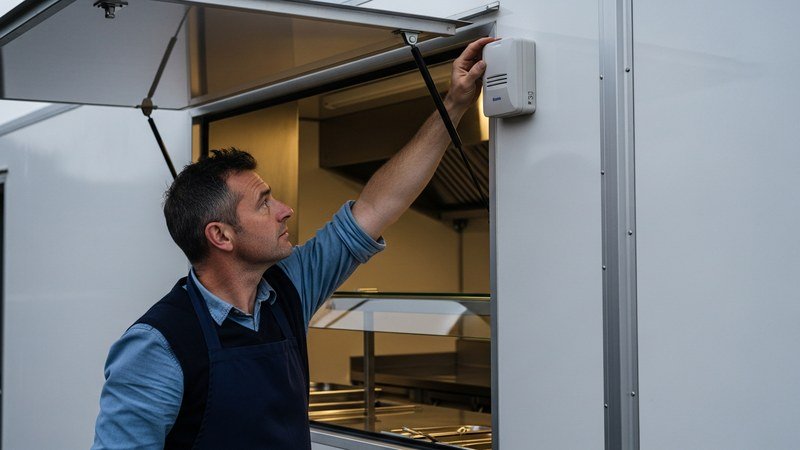
When you've invested money in a food trailer and started trading, you'll want to take every sensible precaution to protect it. A good alarm is one of the most effective — it keeps your catering trailer protected and safe when you're not around.
The trouble is, plenty of owners don't bother. They rely on the padlocks on the doors and windows, and treat their insurance as a fall-back if the worst happens. But have you thought about how long a food-trailer claim actually takes to pay out?
That delay is exactly why an alarm matters. It's not a substitute for insurance — it works alongside it, deterring theft in the first place and helping your claim go through faster if it does happen. With all that in mind, there's really no excuse not to fit one.
What type of alarm should I consider?
There are two main types of alarm for a food trailer, and they're worlds apart in how well they protect you.
Professional monitored system
- Professionally installed, with trigger points around doors and windows
- Sounds a siren and notifies a monitoring service, who alert the authorities
- Far harder for a thief to disable
- More expensive — but the most effective option
DIY battery alarm
- Cheap and easy to fit yourself
- Sounds when a door or window is opened
- No one is notified — it just makes noise
- Easy for an intruder to switch off
If you can, go with a professional monitored system — it's the one that genuinely protects your trailer rather than just making a noise.
Add a tracker for recovery
Whichever alarm you choose, consider a security tracker too. These are small devices hidden discreetly inside the trailer where they can't easily be found. If your trailer is stolen, the tracker company can tell you where it is so the police can recover it.
Trackers have helped thousands of trailer owners get their property back, and they're becoming standard kit. An alarm to deter, and a tracker to recover — together they cover both sides of the problem.
Don't rely on the alarm alone
An alarm is one layer. Pair it with a wheel clamp, a hitch lock and good door and hatch locks, and you make your unit far more trouble than it's worth. See our full trailer security guide for how the layers fit together.
Tick security off before you trade
The MobCater app's checklist covers security alongside gas safety, licensing and insurance, so nothing slips through the cracks.
Open the free checklistFree 12-step guide forever · Checklist included in the app
Frequently asked questions
Is a DIY battery alarm good enough?
It's better than nothing, but not by much. A DIY alarm just makes a noise and can be switched off by an intruder. A professional monitored system alerts a service who contact the police — that's the one worth having if you can stretch to it.
Will an alarm help with my insurance?
Often, yes. Insurers may offer a better premium when an approved alarm is fitted, and can settle a claim faster when you can prove you had one. Always check your policy wording for what's required.
What's the difference between an alarm and a tracker?
An alarm deters theft and raises the alarm at the scene. A tracker does nothing to stop the theft but helps you locate and recover the trailer afterwards. Ideally you want both.
Can I get an alarm that alerts my phone?
Yes. Many modern trailer alarms include vibration sensors and can send a text, email or push alert to your smartphone if someone tries to tow, rock or open the unit.