
Hiya. This is a question that comes up a lot, and it usually arrives in a bit of a panic, either because somebody is building a trailer and does not know what to order, or because they ran out halfway through a lunch rush. So let me give you the short answer first, then the working behind it.
First, the words, because nobody explains them
When I started, people threw these words at me like I was supposed to already know them, and I nodded along and understood none of it. So here they are in plain English. If you know them, skip down to the next bit.
- LPG
- Liquefied petroleum gas. It is just the proper name for the gas in the bottle. There are two kinds of it, propane and butane, and which one you use matters.
- Propane
- The one you want. Red or orange bottle. It keeps working in cold weather, which is the whole reason it is the catering gas.
- Butane
- The blue bottle. It gives up when it gets cold, so it is wrong for a trailer that works outdoors in February.
- Why it is sold in kg, not litres
- Because it is a liquid in the bottle and a gas at the burner, so weight is the only honest measure. A 13kg bottle holds 13 kilos of gas. The bottle itself weighs a fair bit more on top of that, which is why a full 47kg is a two person lift.
- Regulator
- The brass fitting that screws on to the bottle. Gas comes out of a bottle at far too high a pressure for your appliances, and the regulator knocks it down to the pressure they are built for. Propane and butane use different ones.
- Changeover valve
- A gadget that connects two bottles to one regulator. When the first empties it switches to the second on its own, so you do not lose your service. Cheap, and the single best thing on this page.
- Bottle locker
- The vented cupboard on the outside of the unit where the bottles live. Outside, never inside, and vented at the bottom as well as the top.
- CP44
- The gas safety certificate for a mobile catering unit. Your council and most event organisers will ask to see it. Only a Gas Safe engineer with the right commercial catering tickets can issue one.
That is most of the jargon gone. Now the actual answer.
Most full time catering units end up on 47kg propane, with a spare bottle on a changeover valve. A lighter unit, a coffee trailer or a single plate crepe stall, will be fine on 19kg. Whatever you land on, it is propane, not butane, and the bottle lives outside the unit in a ventilated locker.
That is the answer for most people. But the reason caterers get this wrong is not the size of the bottle, it is something nobody tells them about, and I will come to it below, because it is the thing behind nearly every frozen bottle and every dropped flame I have been asked about over the years.
Before any of that, the honest bit. I am not a gas engineer and this page is not a substitute for one. The law says your gas installation has to be fitted and certificated by a Gas Safe registered engineer with the right commercial mobile catering ticket, and nothing you read here changes that. What this page is for is walking in to that conversation knowing what you need, so you are not paying an engineer to explain the basics and you are not buying the wrong bottle twice.
Propane or butane, and why it matters more than people think
Propane. For a catering trailer it is propane, and it is not really a close call. I will explain why, because once you see it you will never mix them up again.
Both are LPG, both come in bottles, and they both burn. The difference is the temperature at which the liquid in the bottle turns back into gas, because that is the only way gas ever reaches your burner. Propane carries on doing that down to about minus 42 degrees. Butane gives up at around freezing point. On a cold morning on a market pitch, a butane bottle will sit there looking perfectly full and deliver you almost nothing.
I have watched that happen to somebody at six in the morning in February, and he was certain the bottle was faulty. It was not. It was the wrong gas for the job, and he had bought it because it was the one the shop had in stock.
| Propane | Butane | |
|---|---|---|
| Keeps working down to | About minus 42C | About freezing |
| Bottle colour | Red or orange | Blue |
| Regulator | 37 mbar, screws on | 28 to 30 mbar, clips on |
| Stored | Outside, always | Indoor use in some settings |
| Catering sizes | 13kg, 19kg, 47kg | 4.5kg, 7kg, 13kg, 15kg |
| Right for a trailer | Yes | No |
Look at the regulator row, because that is the safety point. A propane regulator and a butane regulator are not the same part and they do not run at the same pressure. They do not even connect the same way, propane screws on and butane clips on, and that is deliberate, it is there to stop you doing something daft. If somebody has got around that with an adaptor, your appliances are being fed the wrong pressure. Get an engineer to look at it before you light anything.
A quick way to catch the mistake early: 4.5kg is a butane size. Nobody sells a 4.5kg propane. So if you are looking at a 4.5kg bottle, or somebody has sold you one for your trailer, you are already on the wrong gas.
There is a lot more to this one, including what it actually looks like when butane lets you down and how to spot the wrong bottle before you pay for it, so I have given it a page of its own: propane or butane for a catering trailer.
One more thing, and this one catches people in the shop. The green bottles sold as patio gas are propane, which sounds fine, but they are built for barbecues and patio heaters and they take a clip on fitting rather than the screw fitting your catering regulator uses. They are not the bottle for a catering unit. If it is green, leave it.
Work out your own bottle size
Right, this is the useful bit. Tell it what you actually cook on and how long you trade, and it will give you a size, how many bottles to have on the unit, and how often you will be swapping them. The gas figures behind it are the same ones I have been giving caterers on this site for years.
The bit nobody tells you, and it is not the size
Here is the thing I promised you earlier. A gas bottle does not just hold gas, it has to make it, and there is a limit to how fast it can.
The liquid propane inside has to boil off into gas before it can get to your burners, and boiling takes heat, which it pulls out of the bottle itself. Pull gas off slowly and the air around the bottle keeps up. Pull it off fast and the bottle gets colder and colder, until it cannot boil the liquid quickly enough and your pressure falls away. That is the white frost line you see creeping up the side of a bottle on a busy day.
The size of the bottle sets that limit, because a bigger bottle has more wet surface to boil from. Roughly, and on a mild day:
| Bottle | Comfortable continuous draw |
|---|---|
| 6kg propane | About 0.4 kg an hour |
| 13kg propane | About 0.8 kg an hour |
| 19kg propane | About 1.2 kg an hour |
| 47kg propane | About 2.6 kg an hour |
Now put that next to a twin pan fish and chip range, which gets through something like 2kg an hour. One 13kg bottle can only give you about 0.8kg an hour. So the bottle is nowhere near empty, the gauge looks fine, and the range still will not hold its heat, because you are asking the bottle for more than it can physically produce.
That is why people tell me their bottle froze, or their pressure dropped, or their fryer never got back up to temperature after the first rush. Nine times out of ten it is not a fault. It is too much appliance for too little bottle. The fix is a bigger bottle, or two bottles linked together so the draw is shared, and that is a job for your engineer because it changes the installation.
The finder above checks this for you, and it will tell you if your kit is asking too much of one bottle.
Bottle sizes against the kit you will actually run
These are the figures I have been quoting caterers for years, and they are averages across a trading session rather than the number on the data plate, because an appliance spends a fair bit of its day cycling rather than flat out.
| Appliance | Gas an hour |
|---|---|
| Fish and chip range, twin pan | 1.5 to 2.5 kg |
| Fish and chip range, single pan | About 1.2 kg |
| Griddle, 900mm or bigger | 1 to 1.5 kg |
| Griddle, 600mm | 0.5 to 0.8 kg |
| Four burner hob | About 1.6 kg |
| Pizza oven, single deck | About 1.4 kg |
| Crepe plate | About 0.5 kg |
| Water boiler, 10 to 20 litre | 0.3 to 0.4 kg |
| Dual fuel coffee machine | 0.35 to 0.5 kg |
| Bain marie, wet well | About 0.3 kg |
| Gas fridge, absorption | About 0.025 kg, but all day and all night |
Watch that last line. A gas fridge barely sips gas, but it never switches off, so over a week it quietly adds up to more than your bain marie. If you run one, keep it in your sums.
For what it is worth, when I was trading my gas for cooking ran at about ten to twenty pounds a week. That was cooking only, on propane. If you are running an LPG generator to power an electrical fit out as well, you are in a different league, because then the generator is burning propane to make electricity and that is where most of your gas goes.
Regulators and hoses
For propane in a UK catering unit you want a 37 mbar regulator. That is the standard, your appliances are built for it, and it screws on to the bottle valve. Butane runs at 28 to 30 mbar on a clip on fitting, which is the other reason the two gases are not interchangeable.
On hoses, the part people skip is the date. LPG hose perishes, and it is usually stamped with a date on the outer wall. An EHO or an event organiser checking your paperwork may well also look at your hose, and a cracked or undated hose is an easy thing for them to stop you trading over. Your engineer will replace it as part of a service, so it is not a job you need to take on yourself, but it is worth knowing it is a wear part and not a fit and forget.
A few things worth asking your engineer to fit while they are there, because they cost little and save a lot:
A changeover valve
Two bottles, one regulator. When the first runs out it switches to the second, so you finish the service instead of losing it. If you buy one thing off this page, buy this.
A bubble tester
A small sight glass in the line. Ten seconds before you light up tells you whether anything is leaking. Cheap, and it turns a worry into a glance.
A hose rated for LPG
Not garden hose, not air line, and with a date on it. If you cannot find a date on your current one, it needs replacing.
A gas interlock, if you have a canopy
It stops the gas unless the extraction is actually running. Some councils and event organisers now ask for it, so worth raising before somebody asks you for it.
The certificate, and who can give you one
Your gas installation needs a certificate, and the one people mean when they say gas certificate for a catering trailer is usually a CP44. It is the inspection record for an LPG installation in a mobile catering unit, and your council and most event organisers will ask to see it.
The part that catches people is who can issue it. Being Gas Safe registered is not on its own enough. The engineer needs the right commercial mobile catering tickets on their registration, and plenty of perfectly good domestic engineers do not have them. So when you ring round, ask them straight out whether they are qualified for LPG in mobile catering, and check their Gas Safe card covers it. If you take their word for it and it turns out they were not ticketed for your sort of work, it is you who cannot trade, not them.
Ring your local council too, because they vary. Some want to see the certificate at registration, some only ask when a complaint comes in, and some events want it emailed over before they will confirm your pitch. It costs you a phone call to know which you are dealing with.
The certificate has enough in it to be worth its own page, so if that is the bit you are stuck on, read the gas safety certificate for a catering trailer, which covers how to check an engineer is ticketed and who is going to ask you for it.
Nothing on this page replaces that certificate, or the engineer who issues it. I can tell you what size bottle to order and what to ask for. I cannot sign off your installation, and neither can a calculator.
Storing it and carrying it, which is where the EHO looks
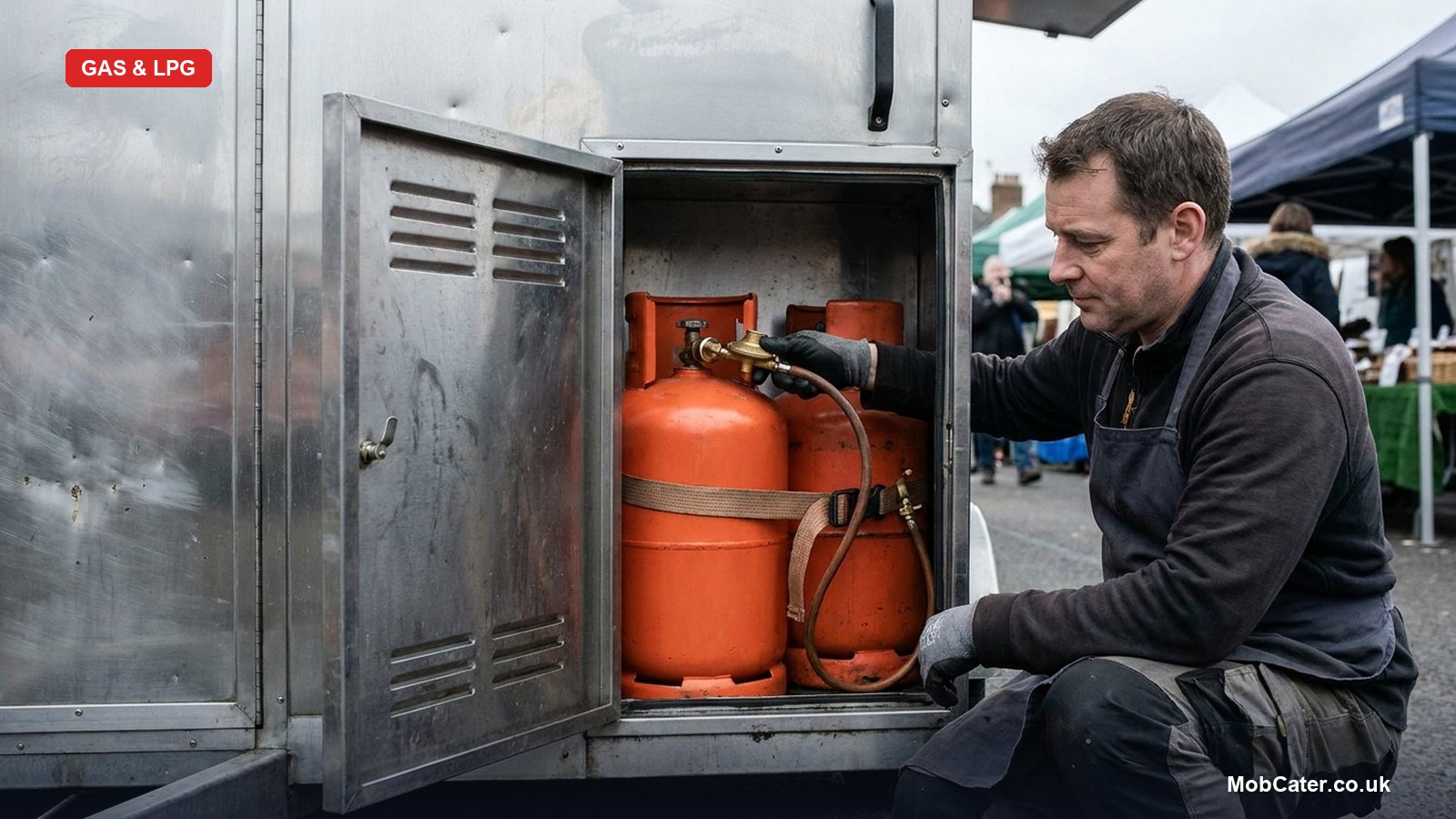
Gas bottles live outside the unit. Not in a cupboard inside, not under the counter, not in the back of the van with your boxes. Outside, in a locker that is vented top and bottom to the open air, with the bottles upright and strapped so they cannot fall over while you are driving.
Upright matters more than people realise. A propane bottle on its side can feed liquid propane into your regulator instead of gas, and that is the sort of thing that turns a small problem into a serious one.
Some things to get right, and these are the ones an EHO or an event safety officer will actually look at:
Vented low down as well as high
LPG is heavier than air, so a leak sinks. A locker vented only at the top collects gas in the bottom. It needs to be able to drain out at floor level.
Turned off and disconnected to travel
Valve shut, and most engineers will tell you to disconnect for the journey. It is also what your insurer expects, so worth checking your policy wording.
Fire extinguisher and a CO alarm
A dry powder extinguisher within reach, and a carbon monoxide alarm in the unit. Both get looked for, and both are cheap next to the alternative.
Spares strapped, not loose
A loose spare bottle rolling about is a hazard on the road and a fail on a pitch inspection. Strap it the same as the one in use.
Tell your insurer you carry LPG, as well. It is a question they ask, and carrying gas you have not declared is an easy way to find out your cover is not what you thought it was on the day you need it.
Where to buy it and get it refilled
Two companies cover most of the UK for bottled propane, Calor and Flogas, and both have a postcode search that shows you your nearest stockist. Between them you will find somewhere local, and local matters, because you will be going back every few weeks for the rest of your trading life.
Neither of those is a paid link. We are not on an affiliate scheme with Calor or Flogas and we get nothing if you click them, they are just the two finders worth using. Where a link on this site does pay us, it says so.
Now, two things about buying that will save you a wasted trip.
The first is that the two ranges are not the same, and the gap is in exactly the size people ask for. Calor sell a 13kg propane. Flogas do not, their 13kg is butane, and their middle propane is an 11kg. So walking into a Flogas stockist and asking for a 13kg gets you butane, which is the wrong gas for your trailer. Ask for propane by name and by weight, every time, and do not assume the person serving you knows it is going in a catering unit.
The second is the money, because it is not just the gas. You pay once to get into the bottle in the first place, and the two companies do it differently.
| Calor | Flogas | |
|---|---|---|
| What the up front charge is called | Cylinder refill agreement | Cylinder charge |
| Cost on a catering size bottle | £69.99 on 13kg, 19kg and 47kg | £47.50 on the smaller sizes |
| Do you get it back? | Partly. Half back at a year, a quarter at two years | No, their page says non refundable |
| Refill on a 13kg propane | About £45.50 | Not sold, their 13kg is butane |
So Flogas is cheaper to start and you never see it again, Calor costs more up front and gives some of it back if you hand the bottle in within a couple of years. Neither is wrong. What decides it for most people is which one has a stockist five minutes away, and honestly that is the right reason to choose.
One last practical note. Whichever you go with, stick with it. Bottles are not interchangeable between companies, you cannot take a Calor bottle to a Flogas stockist for a refill, and you will pay the up front charge all over again if you switch. Pick the one nearest to you and stay there.
Who this page is for, and who it is not
If you are building a unit, or you have just bought one and you are trying to work out what to order, this page is written for you. Same if you have been running on a bottle somebody else chose and you have never been sure it was right.
If you have been trading a few years on gas, most of this you already know, and I would rather say so than pad it out. The one part that might still earn its keep is the bit about how fast a bottle can give up its gas, because that one catches experienced people too, usually the first winter after they add an appliance.
And if you are looking for somebody to tell you that you can skip the engineer, or sign your own certificate, or run a catering burner off a 4.5kg camping bottle because it is what you have in the shed, this is not that page and I am not that bloke. Gas is the one part of this job where getting it wrong does not just cost you money.
Find a Gas Safe engineer who does mobile catering
The app has a directory of 61 engineers who work on catering units, so you are not ringing round domestic firms asking if they are ticketed for LPG. There is a gas and safety checklist in there too, for before an inspection.
See the engineer directoryThe 12-step guide is free forever · no card needed
Questions people ask me about gas bottles
How long does a 47kg propane bottle last?
Divide 47 by the gas you use in an hour. A twin pan fish and chip range at about 2kg an hour gives you roughly 23 hours of cooking, so four or five trading days. A coffee trailer on a dual fuel machine and a water boiler is nearer 0.75kg an hour, which is about 60 hours, so a fortnight of five hour days. The finder above does this for your own kit.
Can I use butane if that is all the shop has?
No. It is a different regulator at a different pressure, and it stops vaporising around freezing point, so it will let you down on exactly the cold morning you cannot afford it. If the shop has no propane, try the other company's stockist finder rather than taking the blue bottle.
Why did my bottle freeze up and lose pressure?
Almost always because you are drawing gas off faster than the bottle can boil it. The liquid takes heat from the bottle to turn into gas, the bottle gets cold, and eventually it cannot keep up. It is a sign the bottle is too small for your kit, or you need two linked together, not that the bottle is faulty. Have a word with your engineer.
How many bottles should I carry?
However many your kit needs to run, plus one spare, on a changeover valve. The spare is not optional in my view. Running dry mid service costs you the rest of the day's takings, and a spare bottle costs a fraction of that.
Do I need a gas certificate for a trailer that only has a coffee machine?
If it burns gas, it needs certificating, however small. A dual fuel coffee machine on LPG is a gas appliance. Ring your local council to confirm what they want to see, because they differ, but do not assume one small appliance means no paperwork.
Can I keep the bottle inside if the locker is sealed?
No. It wants to be outside the unit, in a locker vented to open air top and bottom. LPG is heavier than air so a leak sinks and sits, and a sealed cupboard is the worst possible place for that. Your engineer will not certificate it either.
Is the green patio gas bottle the same as propane?
It is propane, but it is the wrong bottle. Patio gas takes a clip on fitting for barbecues and patio heaters, not the screw fitting your catering regulator uses. If it is green, leave it on the shelf.
Roughly what should gas cost me a week?
When I was trading, gas for cooking ran me about ten to twenty pounds a week on propane. That is cooking only. If you are running an LPG generator to power an electrical fit out, it will be a good deal more, because the generator is burning propane to make your electricity.