
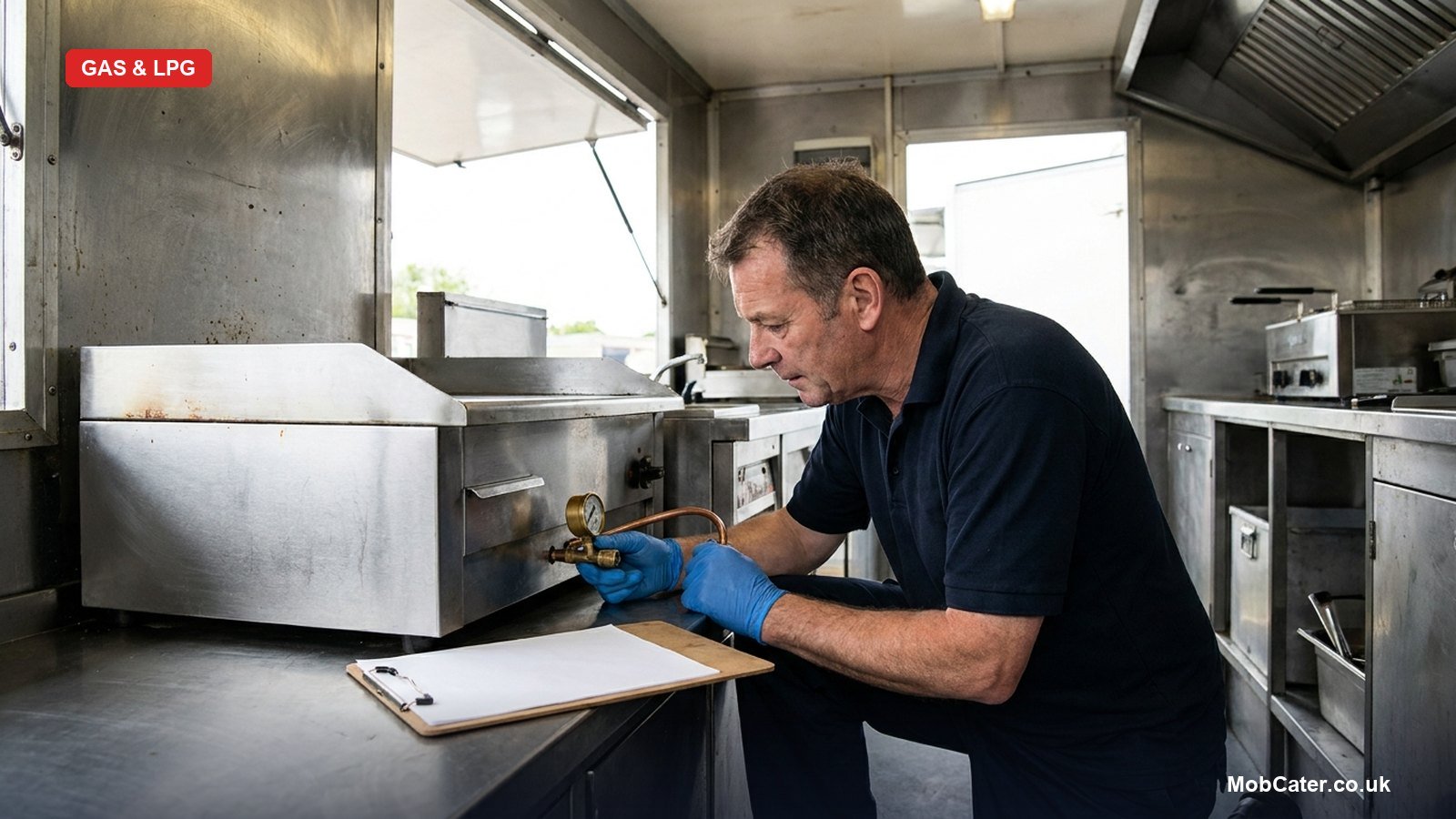
Hiya. This is the bit of paper that stops you trading if you have not got it, and almost nobody explains it properly before somebody asks you for it. So here is what it is, who can give you one, and how to avoid the mistake that costs people a whole season.
If your unit burns gas, you need a current gas safety certificate, and only a Gas Safe engineer with commercial catering tickets can issue one. Being Gas Safe registered is not on its own enough, and that is where this goes wrong for people.
What the certificate actually is
When an engineer inspects the gas in your unit, they fill in a record of what they found. For a mobile catering unit on LPG that record is normally a CP44. That is all CP44 means, it is the name of the form.
It is not a licence you apply for, and it is not something the council issues. It is an engineer's inspection record, signed by them, saying your installation was checked on a given date and what state it was in. You keep it, and you show it to whoever asks.
What they are checking, roughly:
The appliances
That each one is suitable, properly fitted, burning correctly and not giving off anything it should not be.
The pipework and a tightness test
The hard pipe and the hoses, their condition and their dates, and a pressure test to prove nothing is leaking.
The ventilation
That there is enough permanent air in and out for the appliances you run. This is the one that fails units most often, and it is not something you can eyeball.
The bottle storage
That the bottles are outside, upright, strapped, and in a locker vented low as well as high.
The mistake that costs people a season
Here is the one I would most like you to take away.
Gas Safe registration is not one thing. Engineers are registered for specific categories of work, and they carry a card listing which. A brilliant domestic heating engineer who services boilers all day may have nothing on their card for commercial catering or for LPG, and if so they cannot certificate your trailer. Not because they are not good at their job, but because they are not qualified for that category of work.
The trouble is that plenty of them will have a go anyway, in good faith, because you asked and they wanted to help. And you end up with a piece of paper that looks right, that you have paid for, and that an event organiser or an environmental health officer will reject the moment they look at the categories on it.
By then you have usually turned up to trade. That is what makes this expensive.
Ask to see the engineer's Gas Safe card before they start, and check it covers commercial catering and LPG. You can also check their registration on the Gas Safe Register website. Ten minutes of checking beats losing a weekend's trading.
Ask them straight out on the phone: are you ticketed for LPG in mobile catering? A proper commercial catering engineer will not be the least bit offended, because they get asked all the time. If somebody bristles at the question, that tells you something too.
How to find the right engineer
They are thinner on the ground than domestic engineers and they often cover a wide area, so start looking earlier than you think you need to. A fortnight before your first event is not early enough, especially in spring when everybody else is getting ready for the same season.
What works:
Search the Gas Safe Register
Their site lets you search by work type as well as postcode, so you can filter for commercial catering rather than ringing round and hoping.
Ask other caterers near you
The best engineers in this trade travel by reputation. Whoever does the unit next to you at a market is usually worth a phone call.
Ask who the trailer builders use
If you bought from a builder or a dealer, they will have somebody. They need certificates on units all the time.
Use the directory in the app
We keep a list of 61 engineers who work on catering units, so you are not starting from a blank search.
On cost, I am not going to quote you a number, because it moves a lot by area and by how much kit you have, and most of them charge for travel on top. Ring two or three and ask. One thing worth asking as you do: does the price include putting right anything small they find, or is that extra? An inspection that fails and then needs a second visit is the expensive version.
Who is going to ask you for it
More people than you would expect, and not always the ones you prepared for.
| Who | When they usually ask |
|---|---|
| Your local council, environmental health | At registration, or on an inspection visit |
| Event and festival organisers | Before they confirm your pitch, often by email weeks ahead |
| Market operators | When you first apply, and again each year |
| Your insurer | When you take the policy out, and after any claim |
| A buyer, if you ever sell the unit | Almost always, and a missing one knocks the price |
Ring your local council and ask what they want to see and when. Some want the certificate at registration, some only look when a complaint comes in, and some will never ask while the events you trade at ask every single time. It costs you one phone call to know which sort you are dealing with, and it is a much better phone call to make now than on a Friday afternoon.
Keep a photo of the certificate on your phone, as well as the paper copy in the unit. Most of the time somebody asks for it, they want it emailed over, not waved at them.
When you need a new one
Once a year is the normal expectation, and it is what councils, organisers and insurers work to. Put the renewal date in your phone the day you get it, because the year goes quickly and engineers get busy in spring.
You also need it looked at again whenever the gas system changes, and that catches people. Adding an appliance changes it. Moving the bottle locker changes it. Swapping a griddle for a bigger one changes it, because the ventilation was calculated for what was there before. If somebody has been in and altered the pipework, you want that on paper.
And if you buy a second hand unit, treat whatever certificate comes with it as information, not proof. You do not know what has been changed since. Get your own done before you trade.
Who this page is for, and who it is not
This is for you if you are setting up, or you have just been asked for a certificate and you are not sure what is being asked. That is the moment most people meet this for the first time.
If you have been trading for years you will know most of it. The part still worth a glance is the bit about the engineer's categories, because people do get handed the wrong certificate by somebody perfectly well meaning, and it only surfaces when it matters.
What this page is not is a substitute for the engineer or for the council. I am not a gas engineer, I cannot tell you whether your unit will pass, and nothing here is legal advice. It is what to ask for and who to ask, so you walk into it knowing the questions.
61 engineers who work on catering units
Rather than ringing round domestic firms asking if they are ticketed for LPG, start from a list of people who already do this work. There is a gas and safety checklist in there too, for before an inspection.
See the engineer directoryThe 12-step guide is free forever · no card needed
Questions people ask me about certificates
Do I need one if I only have a coffee machine on gas?
If it burns gas, it needs certificating, however small. A dual fuel coffee machine on LPG is a gas appliance. Ring your local council to confirm what they want, because they differ, but do not assume one small appliance means no paperwork.
Can my local boiler engineer do it?
Only if their Gas Safe card covers commercial catering and LPG. Many domestic engineers do not hold those categories. Ask to see the card, and check the registration on the Gas Safe Register site before they start work.
How often do I need to renew it?
Annually is the normal expectation. You also need the installation checked again after any change to the gas system, such as adding an appliance or moving the bottle locker.
I bought a unit with a certificate already. Is that enough?
Treat it as information rather than proof. You do not know what has been altered since it was issued, and it was issued to the previous owner for their setup. Get your own done before you trade.
What if my unit fails the inspection?
The engineer will tell you what needs putting right. It is often ventilation or a perished hose rather than anything dramatic. Ask whether they can fix it there and then, because a second visit usually costs more than the first fix would have.
Is a gas certificate the same as my food hygiene certificate?
No, they are completely separate things. Food hygiene is about how you handle food, gas is about the installation in your unit. You will likely be asked for both, by the same people, at the same time.