
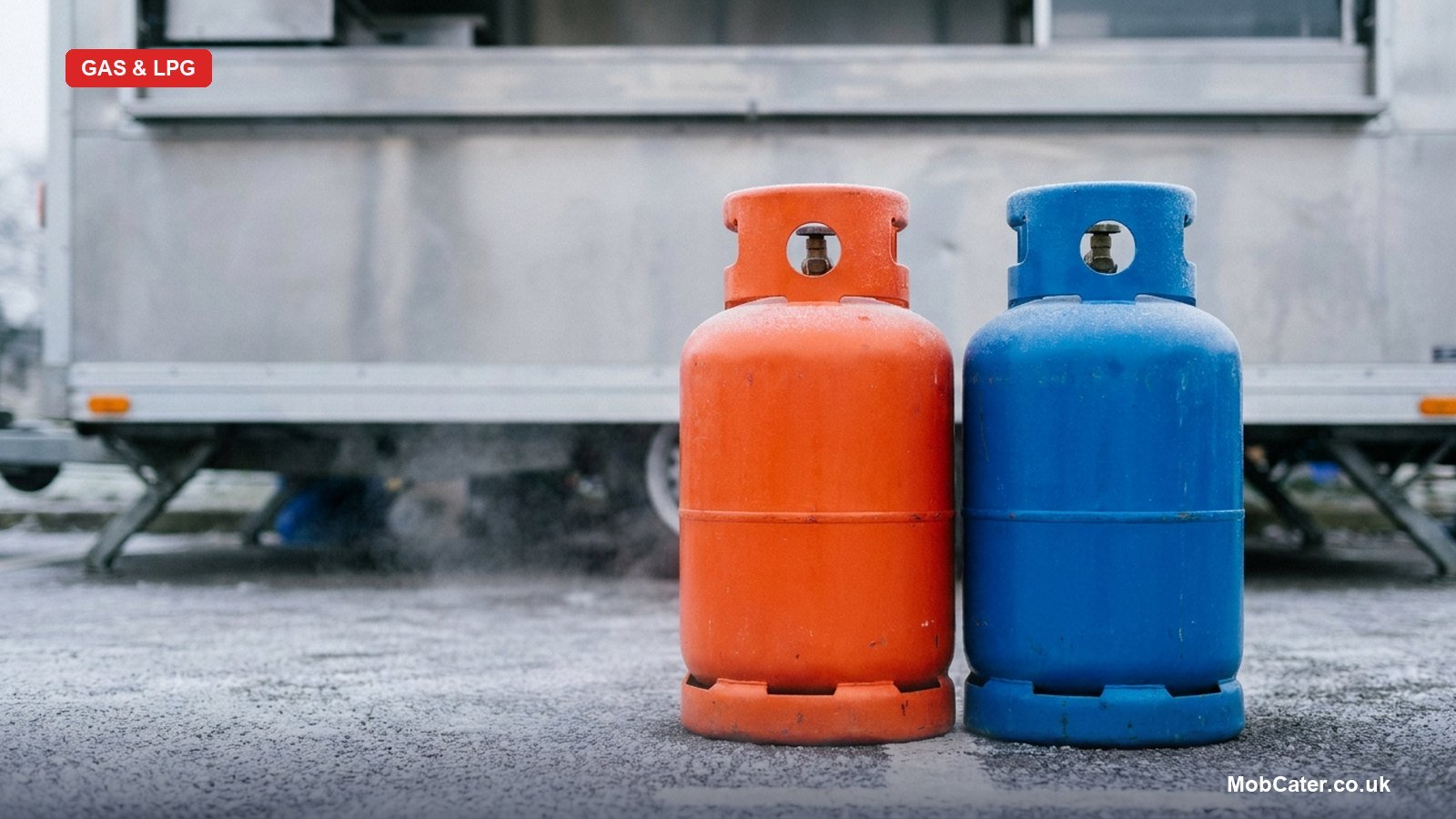
Hiya. Propane. If you only read one line of this page, that is the one. For a catering trailer in this country it is propane, and it is not really a close call. But you deserve to know why, because once you understand it you will never get caught out, and you will spot straight away when somebody is about to sell you the wrong thing.
Propane is the red or orange bottle. Butane is the blue one. For a unit that trades outdoors through a British winter, you want propane. Butane stops working when it gets cold, and it stops at a temperature we see a lot of between October and March.
They are both LPG, so what is the difference?
Both are LPG, which just means liquefied petroleum gas. Both come in bottles, both burn, and sat on the floor of a shop they look like the same product in different colours.
Here is the bit that actually matters, and it is simpler than people make it sound.
Inside the bottle, the gas is squashed into a liquid. That is how they fit so much of it in. But your burner cannot use a liquid, it needs gas. So the liquid has to boil back into gas inside the bottle before any of it can reach your appliances. That boiling happens on its own, as long as it is warm enough.
And that is the whole difference. The two gases boil at completely different temperatures.
| Gas | Still turning into gas down to |
|---|---|
| Propane | About minus 42C |
| Butane | About freezing, 0C |
Propane carries on working in weather this country will never throw at you. Butane packs up at a temperature you will meet on an ordinary morning in November.
What going wrong actually looks like
This is the part worth knowing, because when it happens it does not look like a gas problem. It looks like a broken appliance.
Picture a cold morning on a market pitch. You connect up, you light the griddle, and it burns low. Or it lights and then fades after a few minutes. You check the bottle and it feels heavy, so it is obviously not empty. You start wondering if the regulator has failed, or whether the griddle jets are blocked, and you lose an hour of trading poking at kit that is perfectly fine.
Nothing is broken. The butane in that bottle is still liquid, all of it, because it is too cold to boil. The bottle feels heavy precisely because the gas is all still in there. It simply cannot get out in a form your burner can use.
I watched this happen to a chap in February who was absolutely certain he had been sold a dud bottle. He had not. He had been sold butane, by somebody in a shop who had no idea what he was going to use it for, and he had not known to ask.
A heavy bottle that will not feed your burners on a cold day is the classic sign of butane. Warming it with anything, and I mean anything, is dangerous and is not the answer. The answer is propane.
The regulators are different, and that is on purpose
You cannot simply swap one gas for the other, even if you wanted to, because the fittings and the pressures do not match.
| Propane | Butane | |
|---|---|---|
| Pressure | 37 mbar | 28 to 30 mbar |
| How it connects | Screws on | Clips on |
| Bottle colour | Red or orange | Blue |
| Common sizes | 13kg, 19kg, 47kg | 4.5kg, 7kg, 13kg, 15kg |
Gas leaves a bottle at a pressure far higher than any appliance can take. The regulator is the brass fitting that brings it down to the pressure your kit is built for. Propane regulators and butane regulators bring it down to different numbers, and they connect in different ways, one screws on and one clips on. That mismatch is deliberate. It is a safety feature, there to stop the two getting mixed up by accident.
So if you ever see an adaptor bodged in to make a propane bottle work with a butane regulator, or the other way round, somebody has defeated that safety feature and your appliances are running on the wrong pressure. Do not light it. Get a Gas Safe engineer to look at it. This is one of those things where the cost of being wrong is not measured in money.
Telling them apart before you pay
Three ways to check, and it is worth using all three, because shop staff are not always catering people.
The colour
Red or orange is propane. Blue is butane. Green is patio gas, which is propane but with a clip on fitting built for barbecues, so it is not your bottle either.
The weight on the label
4.5kg, 7kg and 15kg are butane sizes. Nobody makes a 4.5kg propane. If somebody offers you one for a trailer, you are being pointed at the wrong gas.
Say the word out loud
Ask for propane by name and by weight, every time. Do not ask for gas, and do not ask for a 13kg, because at some suppliers a 13kg is butane.
Check the regulator matches
A propane regulator screws on. If the one you are holding clips on, it is a butane or a patio gas fitting and it does not belong on your unit.
That third one catches people out more than any of the others, and it is worth spelling out. Calor sell a 13kg propane. Flogas do not, theirs is an 11kg, and their 13kg is butane. So the exact same words, "a thirteen kilo please", get you the right gas at one counter and the wrong gas at another. Say propane every time.
But is butane not hotter?
You will see this argued online, usually by somebody trying to justify a bottle they already own. On paper butane holds a bit more energy per kilo. It is true, and it does not matter.
Gas you cannot get out of the bottle is worth nothing, however much energy the textbook says is in it. A butane bottle at two degrees is not giving you more heat, it is giving you none. The difference on paper is small, the difference in a car park in January is total.
Pick the gas that will definitely work and stop worrying about the decimal places.
Who this page is for, and who it is not
This is for you if you are putting a unit together, or buying your first bottle, or you have inherited a trailer and you are not sure what somebody else fitted. Those are exactly the moments this goes wrong.
If you have been running on propane for years, there is nothing here you do not already know, and I would rather say that than keep you reading. The one thing worth a look is the regulator table, in case you have ever been handed a bodged adaptor by a previous owner.
And I am not a gas engineer. This page tells you which gas to buy and what to ask for. It does not replace a Gas Safe registered engineer with the right commercial catering tickets, and it is not a substitute for your certificate. Ring your local council and ask what they want to see, because they do vary.
Right, propane. But what size bottle?
The main gas bottle guide has a finder that works it out from what you actually cook on and how long you trade, and tells you how many bottles to carry.
Work out your bottle sizeFree, no sign up
Questions people ask me about this
What happens if I use butane in cold weather?
The liquid stops boiling off into gas, so pressure falls away and your burners go low or out. The bottle still feels heavy, because the gas is all still in there as liquid, it just cannot turn into gas. People assume a fault when it is the wrong gas for the temperature.
Can I use a butane regulator on a propane bottle?
No. Propane runs at 37 mbar on a screw on fitting, butane at 28 to 30 mbar on a clip on. They are deliberately different so they cannot be swapped. If somebody has got round it with an adaptor, your appliances are on the wrong pressure. Have an engineer check it before you light anything.
Is butane ever the right choice for catering?
Not for a mobile unit trading outdoors. Butane suits warm indoor settings and the odd summer use. A trailer has to light at six in the morning in February, and that rules it out.
Is the green patio gas bottle propane?
It is propane, but it is the wrong bottle. Patio gas takes a clip on fitting made for barbecues and patio heaters, not the screw fitting your catering regulator uses. If it is green, leave it on the shelf.
I have been given a butane bottle. Can I get it swapped?
Usually yes, if it is unused and you have the paperwork, but you will likely pay the difference on the cylinder agreement because propane and butane sit in different groups. Ring the stockist before you drive over, and take your receipt.
Does propane cost more than butane?
Per kilo they are in the same ballpark and it moves about. Propane often works out a little cheaper per kilo in the bigger catering sizes, which is a nice bonus, but it is not the reason to choose it. You choose it because it works in the cold.