When I started, I thought I'd need every gadget under the sun. I didn't. Every successful mobile catering business comes down to four pieces of equipment — get those right and you're in business. Get them wrong and you'll waste money or put customers at risk.
This guide covers the four essentials, what they cost (new and second-hand), and the safety and legal bits that catch people out: CE marks, generator sizing and the gas qualifications your engineer must actually hold.
The four essentials that actually matter
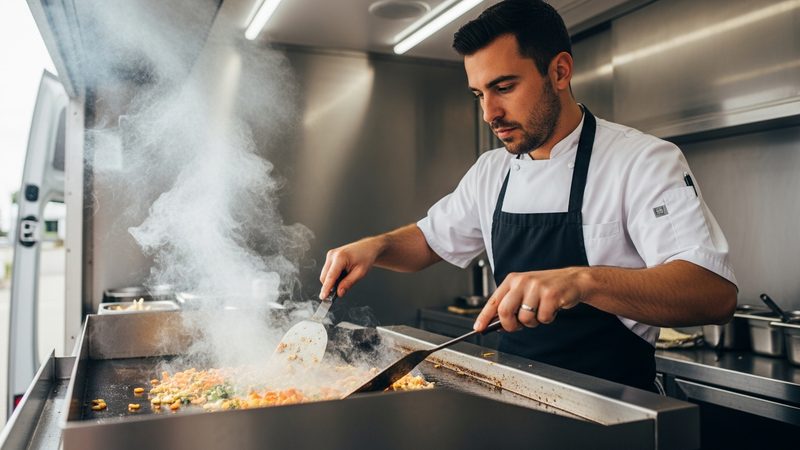
I started with just a 1-burner 24-inch griddle. People thought I was mad — “how will you cook enough?” You work quickly, batch cook and manage your service flow. That one griddle generated excellent income. Scale up to a 2-, 3- or 4-burner as demand grows. Don't overcomplicate it at the start.
Griddle
Your money-maker — where most of the menu is cooked. Start with 1 burner, scale up as demand grows.
Bain-marie
A heated bath that holds cooked food safely above 63°C, ready to serve. Wet or dry types.
Fridge-freezer
Keeps high-risk food at 4°C or below — a legal requirement. Needs LPG / 12V / 230V power.
Tea urn / water boiler
Hot drinks and — just as important — hot water for hand washing. A hygiene requirement.
Members get promotions on over 100 pieces of catering equipment, average saving £42, up to £500 on one item.
All brand new, genuine, CE and UKCA marked, with warranty.
See how the promotions work →The griddle: your money-maker
The griddle is the single most important piece of kit in the van — it's where the profit lives. They come in 1- to 4-burner models, with a surface around 24 inches wide; the number of burners sets your cooking capacity. New ones are pricey (£2,000+), but good second-hand models run £500–£1,500.
Maintenance is simple: scrape the plate through service and keep it clean. Deep clean by heating low, scraping, adding hot water (no detergent), then wiping. Season by heating to a burn-off, cooling and oiling. If it goes rusty, get it professionally sandblasted and seasoned — far cheaper than a replacement.
The bain-marie: keeping food hot and safe
A bain-marie is a heated water bath that holds cooked food hot without drying it out. Wet types need water and monitoring; dry types are water-free and spill-free. A good one keeps food above 63°C so it's ready to serve and compliant. Don't park food in there for hours — rotate it in batches and keep it moving during busy service. New £800–£1,500; second-hand cheaper, but check the heating element and that the temperature control is accurate (the EHO may ask to see your records).
The fridge-freezer: temperature control that matters
You must keep raw ingredients and high-risk food at 4°C or below — it's a legal requirement, not optional. When buying, check three things: the door seal is intact (a poor seal leaks cold air and you lose compliance), it has a working alarm for temperature rises, and — if second-hand — it has a valid LPG test certificate (no certificate, don't buy it). Most run on three power options: LPG, 12V (off the vehicle battery while towing) and 230V mains. New £1,500–£3,000; second-hand much less — ask the seller to demonstrate it working and show the certificate.
The tea urn and water boiler
You need a tea urn or large water boiler for hot drinks and for hot hand-washing water — that second part is a hygiene requirement, not a convenience. A 10-litre urn is a good starting point; go larger as you grow. New £200–£600, second-hand cheaper — just check the heater holds temperature through a full day's trading.
The generator: powering everything
Unless your pitch has mains electricity, you'll need a generator — typically 3.5–6kVA, powering your fridge, kettle, lights and more. To size it, list each appliance's wattage (on the nameplate) and put it into the free generator calculator below; most units settle on 4–5kVA. Store it in the back of the trailer, keep it away from gas equipment and exhaust, lock it to a fixed object against theft, and service it yearly. Low-noise (and increasingly LPG) models are preferred at events.
Not sure what size generator you need?
Hiya, this is the question I get asked most about power. Add up what you’re running and this free calculator on mobcater.com will tell you the size. It’s the one I’d use before spending a penny.
Work out your generator size →Could you run on battery instead?
Some pitches won’t allow a generator, and a small setup running a grinder, a pump and a card reader may not need one. This free calculator on mobcater.com works out what size power station would cover your day. Worth a look before you buy a generator you might not need.
Size a power station →What it all costs — new vs second-hand
| Equipment | New | Second-hand |
|---|---|---|
| Griddle | £2,000+ | £500–£1,500 |
| Bain-marie | £800–£1,500 | Less — check the element |
| Fridge-freezer | £1,500–£3,000 | Less — needs LPG cert |
| Tea urn / water boiler | £200–£600 | Cheaper |
| Generator (4–5kVA) | £1,500–£3,000 | Less |
| Full setup | £10,000–£20,000+ | £3,000–£8,000 |
Annual running costs (gas certification, servicing) typically come to £200–£400 a year.
CE mark: non-negotiable on every piece
Every piece of catering equipment must be CE marked — the mark shows it's been tested to health-and-safety standards. Without it, equipment won't pass the LPG test and won't be approved by environmental health.
Gas safety and LPG engineers: the critical requirement
All LPG equipment must be installed, tested and certified by a fully qualified Gas Safe registered engineer — that's the law. But not every Gas Safe engineer qualifies: for mobile catering they must have all three of these on their Gas Safe ID card:
- LPG
- Commercial catering
- Commercial mobile catering
Domestic or caravan engineers do not qualify — the regulations are different. Find local engineers at gassaferegister.co.uk and ask directly: “Do you have the Gas Safe qualifications for commercial mobile catering?” Check their ID card — photo, valid dates, and “commercial mobile catering” listed on the back. Councils now verify this on the register, so if your engineer lacks all three the council will reject your certificate and you'll pay to have the work redone. Get it right first time. Annual safety inspections are required by law (typically £80–£150) — keep the certificates; the EHO will ask for them.
Buying second-hand smartly
You don't need new equipment to start — second-hand is absolutely fine if you buy smart. Test everything before paying: run the griddle, confirm the bain-marie heats, listen to the fridge running. Always insist on an LPG test certificate for second-hand gas equipment — no certificate, no deal. Good sources: catering auctions, Facebook Marketplace, Gumtree, eBay, equipment suppliers who take trade-ins, and other caterers moving up. Never buy gas equipment sight unseen — arrange to see and test it in person.
Plan your kit in the app
The MobCater app's free guide and equipment checklist help you spec your kit, new vs second-hand, so you know what you need before you spend a penny.
Open the free guideFree forever, no card needed · auto-budgeting with the Startup Cost Calculator is in the Business Toolkit (£5.99/mo)
Frequently asked questions
What's the most important piece of equipment?
The griddle. It's your primary revenue generator — where the food and the profit happen. Everything else supports storage, temperature control and hygiene, but if your griddle fails you can't trade that day.
Do I need a generator?
Unless your pitch has mains electricity, yes. A generator powers your fridge, lights, kettle and other equipment; 4–5kVA is standard. Without power your fridge won't run and you can't meet temperature-control rules.
How much does catering van equipment cost?
A basic new setup runs £10,000–£20,000+. Second-hand, you can do it for £3,000–£8,000, or build gradually from £2,000–£5,000. Budget £200–£400 a year for gas certification and maintenance.
Can I buy second-hand equipment?
Yes — many successful caterers start second-hand. Buy smart: test everything before paying, verify CE marks are present, check gas equipment has a valid LPG certificate, and walk away from anything that doesn't add up.
What size griddle do I need?
Start with what you can afford and manage. A 1-burner is surprisingly productive — I made great money with mine. A 2-burner suits burgers and bacon, a 3-burner gives real volume, and a 4-burner+ is premium kit for established operations. Scale up as demand grows.